Adobe has deemed that the Flash content on web pages is too risky to be used by the general internet user. For virtually all modern browsers, support for Flash was eliminated on 1-1-2021. This means that those browsers will not display any of the interactive Flash demos/calculators/graphics on this (or any other) site.
The simplest (not the best) fix, for now, is to download the Ruffle extension for your browser. It will render the Flash files where they were previously blocked. In some browsers, you will have to click on the big 'play' button to make the Flash applets/graphics visible.
An alternative to Ruffle for viewing Flash content is to use an alternative browser like the older, portable version of Chrome (chromium), an older version of Safari for Windows or one of several other browsers. More information on Flash capable browsers can be found HERE. It's not quite as simple as Ruffle but anyone even moderately familiar with the Windows Control Panel and installation of software can use Flash as it was intended.
Wire
As you already know, wire comes in many different styles and sizes. The information on this page will cover many of the design parameters that you must consider when choosing wire. The most important consideration is the amount of current that will be carried by the wire. The wire's size is indicated by gauge. The most common wire sizes used in car audio range between 4awg and 22awg. The larger the awg (American Wire Gauge) number, the smaller the wire size.
Note:
Unless otherwise noted, the information on this page is for pure copper wire. Some will apply to copper clad aluminum wire but not all of it. For example, copper clad aluminum wire has more resistance and, although it varies, CCA wire for the same diameter can only safely carry about 60-70% of copper wire.
Resistance: We already discussed resistance. Now you need to realize that all wire has resistance. This is the reason that wire has current limitations. If you remember the formulas from Ohm's law, you will remember P=I^2*R. The power dissipated in wire will be in the form of heat.
For Those Who Refuse to Fuse:
Now let's see what will happen if excess current is passed through a small conductor. We will assume that some imaginary piece of wire (we don't want to destroy a real piece of wire) has 0.01 ohms of resistance (e.g. a 15 foot long piece of 8 gauge wire) and that wire is connected directly to the positive terminal of the battery (without a fuse... assuming that you've read the Fuses page, you know that that's a very bad situation). Now let's say that the other end of the wire is allowed to touch to the chassis of the vehicle (which, in most vehicles, is connected to the negative terminal of the battery). The two battery terminals are essentially shorted together by the wire (through the chassis). In this situation, a very significant amount of current will flow through the piece of wire.
If we wanted to calculate the current flow through the wire, we would use the Ohm's law formula I=E/R. If we use the ideal automotive battery, which is rated at 12 volts, and divide it by the resistance of the wire which is approximately .01 ohms, we get a current of 1200 amps.
I = E/R
I = 12/0.01
I = 1200 amps
Then plug the current
into the formula P=I^2*R. We get:
P = I2*R
P = (1200*1200)*0.01
P = 14,400 Watts
This shows that the wire would dissipate 14,400 watts of heat which would melt the wire's insulation and more than likely ignite everything that comes in contact with the wire (fuel lines, other wires, carpet, plastic, insulation). In comparison, the largest burner on your electric stove will not put out that much heat on high!
When this happens, all you can do is stand back and hope that the wire burns open (to break the circuit -- like the correct fuse would have done). Don't think you could pull the wire loose with your hands (it's over 1000°F when this occurs). It's unlikely that you could get to a pair of wire cutters before the carpet and plastic panels were burning on their own. The best that you can hope for is to be able to pull off of the road and get out of the vehicle before you're seriously injured or killed.
This can also happen if the wire is fused improperly. For example, if the fuse was a 150 amp fuse (often included with fuse holders that accept 4-8g wire), the wire would likely burn before the fuse blew. If you tap off of a larger wire with a smaller wire (commonly done to power crossovers and other signal processors/accessories) and the fuse protecting the large wire was rated significantly higher than the current capacity of the smaller wire, you would again have a fire hazard.
Note:
We could have also used the formula P = E2/R.
P = E2/R
P = 122/.01
P = 14,400 Watts
Safety:
Any time that a tap is made off of a power source (battery, fuse block, distribution block...), you MUST put a fuse inline as close to the source as possible. Another thing to keep in mind is that you must insert a fuse inline anytime that the wire size is reduced, such as a tap off of the main power wire for an amplifier, head unit, equalizer... The fuse must be rated to open (blow) well before the wire starts to overheat. A secondary but very important consideration is environment. Is the temperature going to be extreme, hot or cold? Is there anything like oil, grease or solvents that will come in contact with the wire's insulation? All of these things have to be considered when selecting the wire if you want to build a reliable, well designed system.
Resistance in Speaker Wire:
Many people are told that they need to use very large speaker wire to prevent a noticeable loss in output. For most situations, 16g speaker wire is absolutely fine. In the following calculator, you can see just how little loss you'll have with a given wire size. Keep in mind that 1 dB is generally the minimum difference you'll be able to hear. If the loss is less than 1dB, you'll never hear it. This calculator was originally written when amplifiers were rarely capable of producing more than approximately 1000w into 2 ohms. It's recently been re-written to indicate when the wire needs to be larger to prevent it from overheating. As with any calculators on the site, email me to let me know if you find a problem with a calculator or to recommend improvements. This calculator was modified due to concerns of a visitor to the site.
Loss of Power Output:
Since amplifiers are relatively inefficient and can draw significant amounts of current, it's necessary to use the proper wire size. The following demo shows how much voltage and power is lost with a given wire size. Notice that there is loss in the ground wires also. All of the voltage lost across all of the conductors are added together to give the total loss. That's subtracted from the battery (charging system) voltage. What's left is what the amplifier sees. Notice that the loss is not constant. It's proportional to the power output of the amplifier. At zero volume, there is virtually no current draw and no loss of voltage (battery_voltage=amplifier_voltage). When the amplifier is at or near full power, the drop in voltage is much more significant. Length is in feet. 'Gauge' is American Wire Gauge.
This table shows the amount of current flow which will cause a 1/2 volt drop in a 15 foot run of cable. Many people consider 1/2 volt to be the maximum acceptable voltage loss in a system's main power wire. The 'total amp power' is the total maximum unclipped RMS power output‡ of all of the amplifiers combined. It is based on 60% efficiency (for class AB amplifiers) and a battery voltage of 13.8 volts.
‡ For all of the calculators and tables on this page, unless otherwise noted, 'max power' is the RMS power output when the amplifier is on the threshold of clipping.
Wire Gauge
Current Flow
Max Total Amp Power Class AB (60% eff)
Max Total Amp Power Class D (75% eff)
0 awg
330 amps
2731 watts
3414 watts
1 awg
262 amps
2168 watts
2710 watts
2 awg
208 amps
1720 watts
2151 watts
3 awg
165 amps
1365 watts
1707 watts
4 awg
131 amps
1084 watts
1355 watts
5 awg
104 amps
860 watts
1075 watts
6 awg
82 amps
683 watts
853 watts
7 awg
65 amps
542 watts
677 watts
8 awg
52 amps
430 watts
537 watts
9 awg
41 amps
341 watts
427 watts
10 awg
33 amps
271 watts
339 watts
11 awg
26 amps
215 watts
269 watts
12 awg
21 amps
171 watts
213 watts
13 awg
16 amps
135 watts
169 watts
14 awg
13 amps
107 watts
134 watts
Wire Gauge
Recommended Maximum Fuse Size
00 awg
400 amps
0 awg
325 amps
1 awg
250 amps
2 awg
200 amps
4 awg
125 amps
6 awg
80 amps
8 awg
50 amps
10 awg
30 amps
12 awg
20 amps
14 awg
15 amps
16 awg
7.5 amps
These are the recommended maximum fuse ratings for the corresponding wire size. Using a smaller fuse than what's recommended here will be perfectly safe.
Please note that the recommended fuse ratings are roughly based on 300 circular mils (explained at the bottom of the page) of copper per amp of current. Others may suggest slightly different fuses for a given wire size but these should be generally recognized as safe in most all situations.
For a printable version of this quick reference section, click HERE and print the page that opens in a new tab. To make the page fit on a single sheet, use the print preview option in your browser and select 'shrink to fit' then print the page. Printing to one page is simpler with Firefox or Internet Explorer.
Maximum Power for a Given Wire Size:
If you have a power wire in your vehicle and want to know how much power you can run on it, use the following calculator. If you don't know if you have class A/B or class D amplifiers, leave the efficiency at 50%.
Wire and Fuse Selection:
The following calculator will give basic wire and fuse sizes for the main power wire and for each individual amplifier. Select the class of operation for each amplifier and enter the power output at the right of the amplifier. If you have less that 4 amplifiers, enter zero in the fields that are not needed. Keep in mid that these are just suggestions. If your amplifiers don't have internal or on-board fuses, use the manufacturers suggested fuse in the distribution block. The fuse sizes given are to protect the vehicle from fire not necessarily to protect the amplifier.
Enter the total power output of all of your amplifiers, length of the power wire, wire gauge you intend to use, battery (charging system) voltage and amplifier efficiency below.
It will calculate the total voltage drop you can expect in your main power wire at full power output.
Note: Class A/B amplifiers (most amplifiers) are generally 50-60% efficient at full power. Class D amplifiers are about 70-80% efficient at full power. Both are much less efficient at less than full power.
Notice how the current draw increases as the efficiency decreases (and vice versa).
Notes:
If there was a warning of too few circular mils in the calculator above, the wire that you've chosen may have problems with overheating at full power. You will get this warning when you punch in the numbers for something like a short piece of 8g wire to go between the distribution block and the amplifier. Some people use a single strand of 8g wire to make the connection between the dblock and an 800 or 1000 watt amp. Even though the voltage drop in that short piece of wire may not be significant, the power dissipation may be sufficient to soften/melt the insulation. The value of 300 circular mils per amp of current is somewhat arbitrary and may lead to some arguments but it is a safe value.
Many people find this page when searching for wire current carrying capacity for AC circuits. The voltage drop given by this calculator is for one conductor (such as the power wire from the battery to an amplifier). For 2 conductors (such as are used for 120 volt equipment) the voltage drop would be twice the values given by the calculator.
Oxygen Free Copper:
< RANT >
As you have probably noticed, wire designated as OFC wire usually has a clear insulation and the wire is bright and shiny underneath the transparent insulator. Well... It is nice and shiny for a while but after a short time (actually from the time it is drawn), it starts to oxidize (unless the wire is kept in an oxygen free atmosphere). When copper oxidizes, it becomes a less effective conductor. This means that, in time, the wire's current carrying capabilities will become significantly reduced. The problem is made worse by having many very small conductors. This creates even more surface area which makes the oxidation process even more efficient. In my opinion, if you are designing a system of any type for long term use, I think the better choice is a 'tinned' copper wire (often sold as marine grade wire or boat wire). In this type of wire, the copper is plated with tin or similar conductor (maybe a lead/tin or bismuth/tin alloy) which will not oxidize as quickly and never as completely as the bare copper. As a side note, this has nothing to do with the copper being 'oxygen free'. It has everything to do with the fact that the wire is unprotected (untinned) and is finely stranded. I used OFC wire in this example because most OFC has many fine unprotected strands.
< /RANT >
Tech Tip
Wire Connections and Resistance:
Whenever making connections, make sure that they are tight. If you're making crimp connections, try to pull the wire out of the connector. If you can pull the wire out of the connector, it wasn't crimped good enough. If you are inserting the wire into a terminal block, tighten the screw down tight. If there is a bad connection and a sufficient amount of current flow through the junction (wire to terminal block), the block will heat up and possibly do irreparable damage to the terminal block or the printed circuit board (if the terminal block is on your amp).
Calculating Resistance and Cross Sectional Area
Calculating Resistance:
At some point in time, you may need to determine the resistance in a length of wire but you may not have a reference book available. This section will help you to calculate resistance for different wire sizes and lengths. To make quick calculations with an easy reference I use 10g wire as the starting point. It's resistance is approximately 1 ohm per thousand feet of wire length which makes it easy to remember. For non critical calculations, I round it to 1 ohm/1000 ft or 0.001 ohms/foot of wire. If you have a 15 foot run of 10g wire and want to determine the resistance in that run of wire (like the calculator does above), you simply multiply the resistance per foot by the length of the wire.
Resistance = .001*15
Resistance = .015 ohms
Different Wire Gauges:
The previous calculation is great if you're using 10g wire but what if you have a different wire gauge. Although wire resistance can be calculated using a logarithmic scale, I'm going to keep it simple here and use a simple multiplier. For each single digit change in the gauge, the resistance changes by a factor of ~1.26. This means that an 11g wire would have a resistance of approximately 1.26 ohms per thousand feet of wire (remember that we're using 10g wire as a reference and it has a resistance of 1 ohm per thousand feet). A 9g wire would have a resistance of ~.79 ohms per thousand feet (1 ohm/1.26). You can easily step through the wire sizes by continuing to multiply each consecutive value by 1.26. If you have to calculate the resistance of a wire with a significantly larger or smaller gauge (like 4g power wire), you can use the following formula:
For 4g wire:
Resistance = 1/1.26^(difference between 4g and 10g)
Resistance = 1/1.26^6
Resistance = 1/4 ohms per 1000 feet of wire
Resistance = .25 ohms per 1000 feet of wire (or 0.00025 ohms per foot)
Or for 16g wire:
Resistance = 1*1.26^(difference between 16g and 10g)
Resistance = 1*1.26^6
Resistance = 1*4 ohms per 1000 feet of wire
Resistance = 4 ohms per 1000 feet of wire (or 0.004 ohms per foot)
Or for 20g wire:
Resistance = 1*1.26^(difference between 20g and 10g)
Resistance = 1*1.26^10
Resistance = 1*10 ohms per 1000 feet of wire
Resistance = 10 ohms per 1000 feet of wire (or 0.01 ohms per foot)
To determine the voltage drop at the current that you expect to pass through the wire, you can use the Ohm's Law formula V=I*R. V is the voltage drop across the piece of wire. I is the current flow through the wire. R is the resistance of the length of wire. If you have 15 feet of 4g power wire and your amplifier will draw 150 amps max...
Voltage Drop = current flow * (length of wire in feet * resistance per foot)
Voltage Drop = 150 * (15*.00025)
Voltage Drop = 150 *.00375 ohms
Voltage Drop = .563 volts at 150 amps of current
Calculating Wire Diameter and Area:
Here in the US, we use the AWG (American Wire Gauge), circular mils and square mils. In most other parts of the world, they use mm2. I'll try to touch on each of these.
Solid Wire Diameter:
This section will address the diameter of solid wire. Stranded wire has air spaces between conductors and different combinations of different gauge strands will result in different overall diameters. Keep in mind that, in the following description, we are talking about the area of the wire in a circular shape. This means that the total cross sectional area is doubled when the diameter is increased by a factor of 1.414.
OK... For a reference that's relatively easy to remember, lets use 10g wire again. It's ~0.1" in diameter. If we go up in wire size 6 sizes again (to 4g), the diameter is going to be double the 10g wire. The multiplier is ~1.123 per gauge.
Diameter = .1*1.123^(difference between 4g and 10g)
Diameter = .1*1.123^6
Diameter = .1*2.005
Diameter = approximately 0.2" in diameter
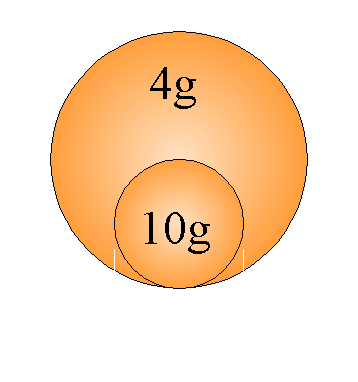
This image shows the relative difference between 10g and 4g wires (not actual size). You can easily see that doubling the diameter quadruples the cross sectional area.
Until now we've only discussed the diameter of the wire. The cross sectional area of round wire is the one-half of the diameter (the radius) squared then multiplied by Pi (r2*3.14). For some conductors like buss bars and circuit boards, you won't have a wire gauge or diameter to use to see how much current a conductor can handle. Circular mils, square mils and mm2 allow us to express the cross sectional area and therefore calculate the resistance for the conductor. It has another advantage over simply stating the diameter of a conductor in that it doesn't matter if the wire is stranded or solid. If a cross sectional area is given in in circular mils, square mils and mm2, spaces between conductors are no longer a factor.
Circular Mils:
One 'mil' is one thousandth of an inch. A wire with a cross sectional area of 1 circular mil has a diameter of .001". If we need to calculate the circular mils for a 10g wire, we simply square the diameter in mils. Since the 10g wire has an approximate diameter of .1" or 100 mils, we square 100 and get 10,000 circular mils. 10g wire actually has a cross sectional area of 10,384 circular mils but for car audio appliciations, 10,000 circular mils will be close enough and easy to remember.
Note:
Various wire tables list slightly different values for circular mils and the diameter of the different wire sizes. The values here are a rough average of the various tables I've found.
Circular Mil Foot:
A circular mil foot is a piece of wire with a cross sectional area of 1 circular mil and a length of 1 foot. To calculate the resistance for a length of wire, there are a couple of things you need to know. The first, cross sectional area in circular mils, has been discussed. The second, the length, is known (15 feet in this example). And the Third is the Specific Resistivity for the conductor. The Specific Resistivity is the value of resistance for a circular mil foot of wire. For copper, the SR is 10.37. To determine the resistance for a 15 foot long piece of 10g wire we can use the following formula:
Resistance = SR*(length of wire/cross sectional area in circular mils)
Resistance = 10.37*(15 feet/10384 circular mils)
Resistance = 0.015 ohms for a 15 foot length
For 4g wire:
Resistance = SR*(length of wire/cross sectional area in circular mils)
Resistance = 10.37*(15 feet/41534 circular mils) (4g wire has 41534 circular mils)
Resistance = 0.00375 ohms for a 15 foot length
As you can see, we got the same resistance for the 15 foot long piece of 10g wire as before (with an entirely different method). If you were using a different type of wire like silver, gold or aluminum, the specific resistance would be different. You should also know that the SR used here is for copper at or near room temperature (~70F).
Square Mils:
Square Mils are similar to circular mils in that their outer dimensions are again 1 mil but this time we're talking about the area of a square instead of a circle. This makes a square mil slightly larger than a circular mil. The conversion factor to convert from one to the other is:
1 circular mil = .7854 square mils
or
1 square mil = 1.273 circular mils
This diagram should help you understand the difference between a circular and a square mil.
Square Millimeters:
In Europe and other parts of the world, they use a somewhat less confusing system to express wire cross sectional area. They express it in square millimeters(mm2). For square conductors, it is simply the height times the width of the conductor in millimeters. For round conductors, it's the radius (half the diameter) of the conductor squared then multiplied by Pi.
For example a 10g conductor with a diameter of ~2.6mm:
Area of the conductor = radius of conductor squared*Pi
Area of the conductor = R2*3.14
Area of the conductor = 1.32*3.14
Area of the conductor = 1.69*3.14
Area of the conductor = 5.3 mm2
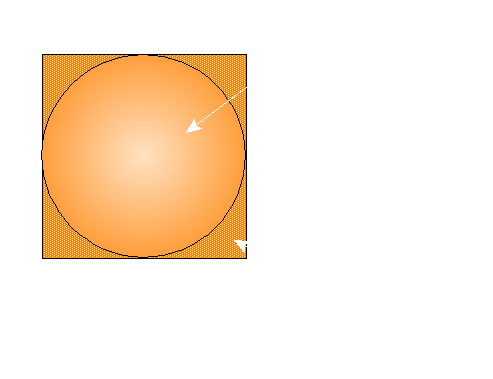
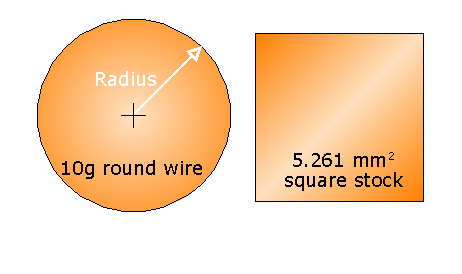
The following diagram shows the relationship between a piece of solid round wire and a piece of square copper stock with the same area (and therefore the same resistance for a given length).
Square Millimeters to Circular Mils:
To convert from mm2 to circular mils, multiply by 1973.
The answer we got (10457) is a little off from the actual value of 10384 circular mils for 10g wire but that's because we didn't have enough significant digits for the area of the wire. If we'd used the more accurate value of 5.26, we'd have been closer to the actual cross sectional area. Either value is close enough for this tutorial and anything related to car audio.
Solid Wire Table:
The values in the first table are based on a value of 10,000 circular mils for 10g wire. I skewed the values slightly so you could see how the diameter and cross sectional area of one wire relates to the others. Remember that 10g wire is the reference. The second table is more accurate. The values on either table would be good enough for calculations in car audio applications.
Solid Wire Dimensions and Resistance Skewed for clarity
A.W.G.
Ohms per foot
Circular Mils
Diameter (inches)
4/0
0.00004961
201585.18
0.4490
3/0
0.00006250
159998.40
0.4000
2/0
0.00007875
126990.92
0.3564
0
0.00009921
100792.84
0.3175
1
0.00012500
79999.40
0.2828
2
0.00015749
63495.62
0.2520
3
0.00019843
50396.55
0.2245
4
0.00025000
39999.80
0.2000
5
0.00031498
31747.89
0.1782
6
0.00039685
25198.34
0.1587
7
0.00050000
19999.95
0.1414
8
0.00062996
15873.98
0.1260
9
0.00079370
12599.20
0.1122
10
0.00100000
10000.00
0.1000
11
0.00125992
7937.01
0.0891
12
0.00158740
6299.62
0.0794
13
0.00200000
5000.01
0.0707
14
0.00251983
3968.52
0.0630
15
0.00317479
3149.82
0.0561
16
0.00399998
2500.01
0.0500
17
0.00503965
1984.26
0.0445
18
0.00634956
1574.91
0.0397
19
0.00799994
1250.01
0.0354
20
0.01007928
992.13
0.0315
21
0.01269909
787.46
0.0281
22
0.01599984
625.01
0.0250
23
0.02015852
496.07
0.0223
24
0.02539812
393.73
0.0198
25
0.03199960
312.50
0.0177
26
0.04031694
248.03
0.0157
27
0.05079611
196.87
0.0140
28
0.06399904
156.25
0.0125
29
0.08063367
124.02
0.0111
30
0.10159197
98.43
0.0099
31
0.12799776
78.13
0.0088
32
0.16126694
62.01
0.0079
33
0.20318344
49.22
0.0070
34
0.25599488
39.06
0.0063
35
0.32253307
31.00
0.0056
36
0.40636586
24.61
0.0050
37
0.51198848
19.53
0.0044
38
0.64506453
15.50
0.0039
39
0.81272970
12.30
0.0035
40
1.02397440
9.77
0.0031
Solid Wire Dimensions and Resistance More Accurate
A.W.G.
Ohms per foot
Circular Mils
Diameter (inches)
4/0
0.00004955
209322.28
0.4575
3/0
0.00006242
166139.20
0.4076
2/0
0.00007865
131864.77
0.3631
0
0.00009909
104661.14
0.3235
1
0.00012485
83069.60
0.2882
2
0.00015730
65932.39
0.2568
3
0.00019818
52330.57
0.2288
4
0.00024969
41534.80
0.2038
5
0.00031460
32966.19
0.1816
6
0.00039636
26165.28
0.1618
7
0.00049939
20767.40
0.1441
8
0.00062919
16483.10
0.1284
9
0.00079273
13082.64
0.1144
10
0.00099878
10383.70
0.1019
11
0.00125838
8241.55
0.0908
12
0.00158546
6541.32
0.0809
13
0.00199755
5191.85
0.0721
14
0.00251676
4120.77
0.0642
15
0.00317092
3270.66
0.0572
16
0.00399511
2595.93
0.0510
17
0.00503352
2060.39
0.0454
18
0.00634184
1635.33
0.0404
19
0.00799022
1297.96
0.0360
20
0.01006704
1030.19
0.0321
21
0.01268368
817.67
0.0286
22
0.01598043
648.98
0.0255
23
0.02013408
515.10
0.0227
24
0.02536735
408.83
0.0202
25
0.03196086
324.49
0.0180
26
0.04026816
257.55
0.0160
27
0.05073471
204.42
0.0143
28
0.06392172
162.25
0.0127
29
0.08053632
128.77
0.0113
30
0.10146941
102.21
0.0101
31
0.12784345
81.12
0.0090
32
0.16107265
64.39
0.0080
33
0.20293882
51.10
0.0071
34
0.25568689
40.56
0.0064
35
0.32214530
32.19
0.0057
36
0.40587764
25.55
0.0051
37
0.51137379
20.28
0.0045
38
0.64429060
16.10
0.0040
39
0.81175529
12.78
0.0036
40
1.02274758
10.14
0.0032
The Following calculator will allow you to enter whole and fractional wire gauges (fractional wire gauges are used for magnet wire) between 0000 and 46 gauge. It also allows direct current input instead of having it calculated like the calculator above. After all of the material we just covered, it should be self-explanatory. Due to different rounding on the spreadsheet and the calculator, the values will differ slightly between the calculator and the table above.
Wire Insulation Types
Definitions
PVC:
PVC is short for PolyVinyl Chloride. Different formulations make the material soft and suitable for wire insulation or hard and suitable for water and drain pipe.
Thermoplastic:
A thermoplastic is a plastic that can be softened by heat which allows it to be easily formed. Different types of thermoplastics are PVC, Polyethylene and Polypropylene.
Latex:
A light colored fluid produced by various plants and used to make latex rubber products.
Common Wire Designations
The following designations will help you understand the properties of thhn and other wire types. Keep in mind that these are general properties. There will be exceptions to these rules. Before you use any wire in a critical situation, consult the datasheet from the wire's manufacturer.
T
Thermoplastic insulator (generally PVC)
H
Dry location - household/building wire (generally the first 'H' if there are 2 Hs)
High temperature (second H if there are 2 Hs)
N
Nylon outer insulator (protects against abrasion)
S
Silicone rubber (if used at beginning of designation) Generally used in high temp applications.
Switchboard wire (if used at end of designation)
B
Braided
W
Wet locations
R
Rubber (non specific)
RU
Latex rubber
A
Asbestos
F
Fixture Wiring
Specific Wire Designations (individual conductors)
THHN
High temperature (90°C 194°F max.) thermoplastic for use in dry locations like building wiring with a nylon outer insulator.
THWN
Standard temperature (75°C 167°F) thermoplastic for use in wet or dry locations with a nylon outer coating.
RW
Moisture resistant rubber
R
Rubber
RH
Rubber moderate temperature (75°C 167°F)
RHH
Rubber high temperature (90°C 194°F)
TBS
Thermoplastic insulator with braided cover (generally used for switchboard applications)
RUH
Heat resistant latex rubber
You should remember:
Wire has resistance and therefore will have a voltage drop across the length of it any time current is flowing through it.
This site was started for pages/information that didn't fit well on my other sites. It includes topics from backing up computer files to small engine repair to 3D graphics software to basic information on diabetes.
This site introduces you to macro photography. Macro photography is nothing more than the photography of small objects. It can take quite a while to understand the limitations associated with this type of photography. Without help, people will struggle to get good images. Understanding what's possible and what's not possible makes the task much easier. If you need to photograph relatively small objects (6" in height/width down to a few thousandths of an inch), this site will help.
If you're interested in air rifles, this site will introduce you to the types of rifles available and many of the things you'll need to know to shoot accurately. It also touches on field target competition. There are links to some of the better sites and forums as well as a collection of interactive demos.
This site helps anyone new to computers and anyone with a basic understanding of computers with a desire to learn more about the internal components of a computer. If you have a computer that you'd like to upgrade but don't know where to start, this is a good site for you.
This site is for those who want to begin racing karts but don't fully understand how the various parts work. It's mostly interactive demos that show how the various parts of the kart work.
Click HERE to visit a friend's new car audio tech site.




 As you already know, wire comes in many different styles and sizes. The information on this page will cover many of the design parameters that you must consider when choosing wire. The most important consideration is the amount of current that will be carried by the wire. The wire's size is indicated by gauge. The most common wire sizes used in car audio range between 4awg and 22awg. The larger the awg (American Wire Gauge) number, the smaller the wire size.