
|
| Email Home Page |
|

|
|
|
| Email Home Page |
|
|
|
All voltages and currents that we have discussed so far have been of the DC variety. The next section will describe the difference between AC and DC voltages.
Direct Current:
Alternating Current:
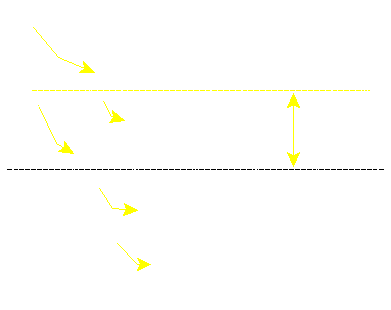 If you look at the diagram above you will see that the DC voltage is constant. The AC waveform (a sine wave in this example) is continuously changing. Let's say that the voltage of "Z" is 10 volts DC. The AC waveform has a few points on it marked. The instantaneous voltage at those points are listed below. Please understand that the voltages are only at that point in time. If the waveform voltage was measured with a volt meter, it would read approximately 10 volts AC. All voltages are referenced to the black line. |
|
You should remember: 1.D.C. is a type of voltage which does NOT cross a point of reference at regular intervals. 2.A.C. is a type of voltage which DOES cross a point of reference at regular intervals. |

|

|
|

|


