
|
| Email Home Page |
|

|
|
|
| Email Home Page |
|
|
|
As a side note... The term passive (as in passive crossover) and the 'pass' in high/low pass are not related in any way. Passive means that the filtering is done with passive components only (no need for a power supply). The 'pass' in high/low pass means that the high/low frequencies are allowed to pass through the respective crossovers.
Making the Connection:
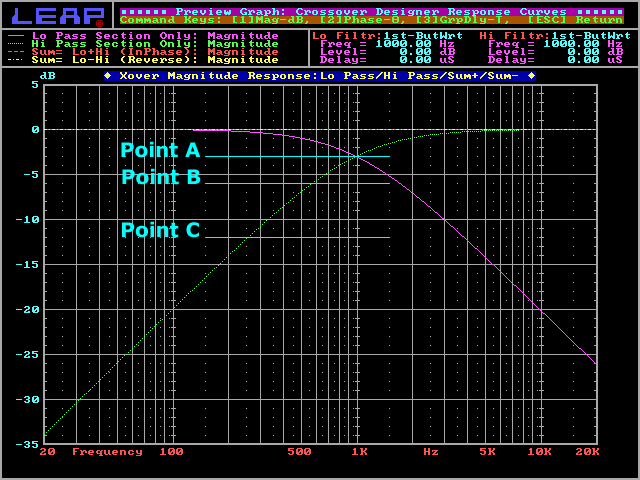
On the following graph, the green line shows how the signal level drops off (rolls off) as the frequency decreases. You can see the green line is virtually unaffected (there is virtually no decrease in the signal level) above ~2khz. At point A, you can see that the signal is down 3dB at 1khz. The 3dB down point is the crossover frequency (for Butterworth alignments). It represents the point where the power reaching the speaker is 1/2 of what it would be without the crossover. At point B, the signal level is down by 6dB. This represents the 1/4 power point. At point C (250hz), the signal is down by 12dB. This means that the amount of power reaching the speaker at 250hz is 1/16 as much as it would be without the capacitor.
 |
|
You should remember:
1.When a properly selected cap is connected in series with a speaker, you can choose the frequency at which the low frequency starts to be reduced. |

|

|
|

|
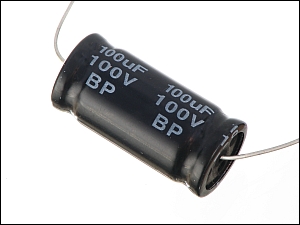 Earlier you were introduced to passive crossovers. The simplest form of high pass crossover is achieved by simply putting a capacitor (like the one at the right) in series with a speaker. The proper capacitor is determined by the desired frequency response and the speaker's rated impedance. This page will cover the basics only. A more in-depth discussion of capacitor selection will be covered on the