----- Critically Important -----
-
Flash graphics viewing/use alternatives:
-
Flash support by most modern browsers has been dropped but that's not the end of the line for Flash.
There is no practical alternative to Flash for the interactive demos/applets/graphics on this site.. Especially when there are alternatives, some simple, some good, some...
-
Ruffle is chosen by most because they can't imagine using anything but their preferred browser. It works. It's OK but not great. The Flash graphics won't look as they're supposed to but it, generally, works.
-
The #1 preferred (by me) way to view the site and the Flash graphics is with the Chromium Portable browser and the installation of the older (no time-out) Flash Player files. This was incredibly simple when people knew computers but not today when people only know how to work with their phones.
-
The Flash Browser is a good option but it's so stripped down that it makes it somewhat difficult to use.
-
The Maxthon browsers are an option. The v4.95 is the easiest (install and use). V5.3.8 and 6.1.0 require (very) slightly more effort (very).
-
All of these browsers are available from my Flash Information page.
-
The Chromium and Maxthon browsers on the page above are 'portable' browsers. They are not installed into your system. They are simply made available for use on your computer. They can be carried around on a Flash drive and used on any computer.
----- Critically Important -----
Electronic Crossovers
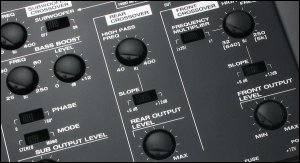 While outboard electronic crossovers are not widely used nowadays, this information is still relevant because it applies to the internal crossovers built into most car audio amplifiers.
A crossover is a filter. It is used to block some frequencies while allowing others to pass with little or no effect. An electronic crossover is a set of active filters which pass/reject part of the audio band. The crossover point is determined by changing the value of resistors and/or capacitors in the active filter circuit. A high pass crossover will allow frequencies above a predetermined point to pass. The frequencies below the crossover point will rolloff at a rate determined by the crossover's design. A low pass crossover would let low frequencies pass while reducing the level of the high frequency part of the signal. The signal from the head unit feeds the crossover. The signal leaving the crossover goes to an amplifier. If the high pass output is connected to an amplifier, that amplifier would be connected to smaller speakers which may include tweeters. A low pass xover would drive an amp connected to larger speakers, including woofers.
It was stated that an electronic crossover uses active filters to filter/attenuate parts of the audio spectrum. In virtually all instances, the active filters use operational amplifiers (op-amps -- to be covered later). This is in contrast to passive filters (which you'll be introduced to in an upcoming chapter) that use inductors and capacitors to create the filter. Active filters are used where the power passing through the filter is minimal (preamp level audio). Passive crossovers and filters are used when the power passing through the filter is significant (speaker level audio). There is still (at least) one more type of filter. These are digital filters in DSP (Digital Signal Processor) units. The function of a DSP unit is entirely different. They take in analog or digital audio (analog audio has to be converted to a digital format), use algorithms to produce the desired effects and then convert it back to analog audio. They have several advantages but are generally more expensive to implement.
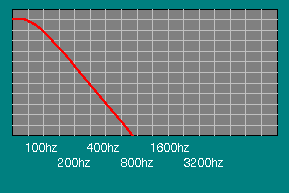
The image below shows how the level of the audio signal rolls off after passing through different types of crossovers. High-pass crossovers pass high frequencies and roll off lower frequencies. Low-pass crossovers pass low frequencies and roll off higher frequencies. If you had a system with a subwoofer for bass and 6x9s for the highs, you would use a low-pass crossover for the woofer and a high-pass crossover for the 6x9s.
Graph Legend:
|
Cyan
|
=
|
6dB/octave
|
|
Red
|
=
|
12dB/octave
|
|
Green
|
=
|
18dB/octave
|
|
Violet
|
=
|
24dB/octave
|
|
|

Place your mouse/cursor over the crossover frequencies to the left of the graph to see how the slope slides (to pass varying amounts of the audio spectrum) as you change the crossover point. The frequencies that fall on the flat part of the 'curve' are passed without any change in their output level. The part of the audio band that falls on the slope of the curve have their output reduced. Their output level is reduced in proportion to the point where they fall on the curve. If they fall on the higher part of the slope, the output is higher than those frequencies that fall on the lower parts of the slope.
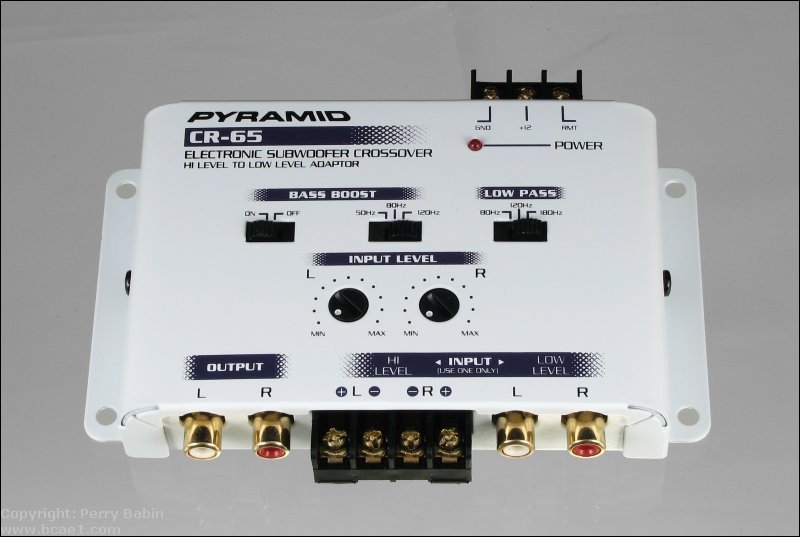
Some electronic crossovers are simple. Many (like the one below) are available with only one set of inputs and one set of outputs and only work as a low pass crossover. This one has both high and low level inputs. High level inputs are designed to accept speaker level signals. Low level inputs are designed for preamp level input. It also has bass boost and multiple options for the bass boost and crossover frequencies. Expect to pay about $20US for a crossover like this.
Crossovers like the next one are more complex and offer more flexibility. It's a 2/3 way crossover which means it can operate in either 2 or 3 way configuration. It's important that you not buy a 3 way crossover if you only need a 2-way crossover because, many times, a 3-way crossover will not allow the entire audio band to play through using only two of the outputs. 2-way crossovers have high and low outputs. 3-way crossovers have low, mid and high outputs. Generally, the midrange cannot extend high enough to play the upper frequencies and the high frequency output cannot pass the lower midrange frequencies. On most crossovers similar to this one, you can use one, two or three pairs of inputs (pair = left and right channels) to produce output from all 3 pairs of outputs.
Click HERE to make this applet fill this window.
-
The crossover above has a lot of features. The following is a brief description of each.
-
Frequency:
The frequency is the point where you want the signal to start dropping off for the filter. For a low pass crossover, like that for the subwoofer output, if you set the frequency to 100Hz, everything above 100Hz (Hertz) will start to drop in level.
-
Bass Boost:
The bass boost provides a boost in the level of low frequency signals. The boost is strongest at the center frequency and it rolls off on either side of that center frequency. The level control determines the amount of boost. The frequency determines the center frequency. Some crossovers and equalizers also include a 'Q' adjustment. This determines the width of frequencies affected by the bass boost.
-
Phase:
The phase switch determines whether the output signal has the same phase or the opposite phase of the input signal. For those who don't understand phase... Think of two people on the swings at a playground. If both are reaching the highest forward point at the same time for each cycle, they are 'in phase'. If one is reaching its highest forward point when the other is reaching its highest rearward point, they're 180 degrees (180°) out of phase which could be referred to as being out of phase. The 0°/180° switch makes the two people swinging reach the corresponding points a the same time (0°) or the alternate points (180°) at the same time. Although speakers generally move too fast to see if they're in phase, if you have speakers that are in phase (0° phase difference), they are all working together to produce bass. If they're out of phase, when one is pushing out, the other is pulling in and they're working against each other.
Don't get the cone movement and phase confused with the very slow movement you see when an amp is driven into clipping. When an amp is not clipping, it controls the woofers very well and when the speakers are driven hard, they're nothing more than a blur. When the amp is driven into clipping, the cone movement is not well controlled and along with the fast movement that makes them a blur, there is a slow movement in and out that's easy to see. When this happens, the speakers may appear to be out of phase but what you're seeing is entirely different. To see speakers out of phase with an audio signal, the frequency would have to be less than 10Hz.
-
Output Level:
This is simply used to set the output level of the corresponding crossover channel (sub/front/rear). Many people set the gains on their amps at 50-75% and balance the levels between the amps with the output level controls on their crossover. Many times, the controls on the crossover are easier to access and don't require a screwdriver to adjust.
-
Slope:
Near the top of this page, you saw a graph with 8 slope curves on it (four high-pass and four low-pass). Crossovers with greater slope cause the signal to roll off faster than those with less slope. For two low-pass crossovers with the same crossover point, the one with greater slope will have less voice and highs playing through the woofers. For two high-pass crossovers with the same crossover points, the one with the greater slope will have less bass getting to the high frequency speakers.
-
Multiplier:
The multiplier switch changes the range of frequencies affected by the frequency control. On this crossover, the front channel control can be used to set the crossover point between 32Hz and 250Hz when set to the x1 position. When set to 20x, the crossover point can be set to any frequency between 640Hz and 5,000Hz (5kHz). When used in 2-way mode, the multiplier would be set to x1 so that the high-frequency amplifier can go down to a low enough frequency take over where the subwoofers start to roll off. In 3-way mode, the front channels would not need to go as low because the speakers and amp connected to the rear channels would fill the gap between the front and subwoofer speakers. In 2-way mode, you'd likely have either component speakers or 6x9s on the front output and woofers on the sub output.
|